Foundation Repair in Canyon Lake, Texas
Canyon Lake is the opposite problem from Seguin. There is almost no clay. There is limestone, slope, fill, and sixty years of houses built on all three in every combination.
Mon to Sat 7am to 7pm. Calls answered, not voicemail.
Building on the plateau
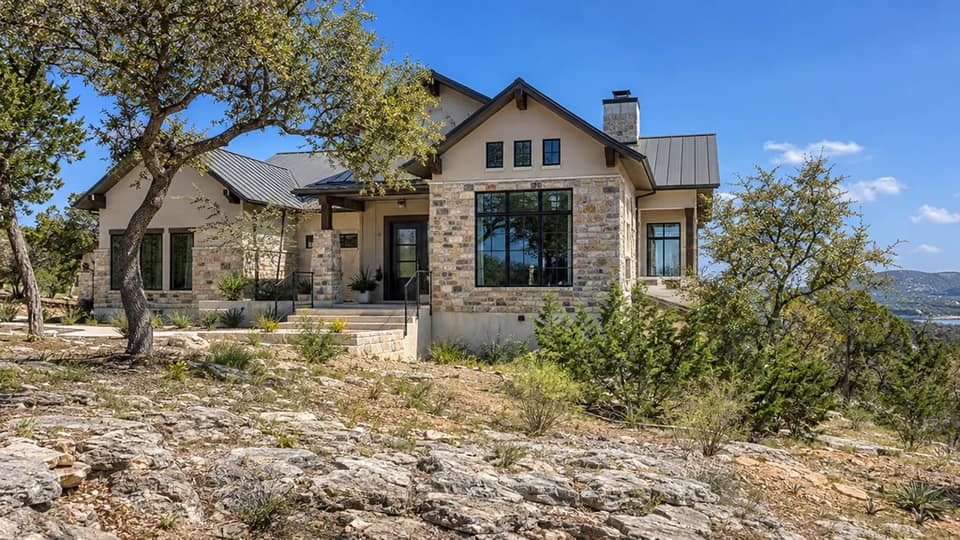
Canyon Dam was finished in 1964, and nearly every house around the lake has gone up since, most of them after 2000. Startzville on FM 2673 had an estimated population of thirty in 1990 and about seven thousand by 2016. That means a lot of houses built fast on ground that is hard to build on: steep lots, ledges of Glen Rose limestone a foot under the surface, and soil so thin that a flowerbed needs imported dirt.
The good news is the clay problem that dominates Seguin and east New Braunfels mostly does not exist here. Comfort, Rumple and Eckrant soils are shallow and stony with little shrink-swell. A slab that bears fully on rock in Canyon Lake Hills or Mystic Shores does not move with the weather.
The problem is that very few slabs bear fully on rock. To make a flat pad on a hillside, builders cut into the uphill side and push the spoil downhill as fill, then pour the slab across both. The uphill half sits on limestone. The downhill half sits on fill that may be two feet deep at the cut line and eight or ten feet deep at the far corner. If that fill was placed in thick lifts, placed wet, or never compacted with the right equipment, it settles for years. The slab bends at the transition, and the signature Canyon Lake crack runs diagonally across the garage or living room toward the downhill corner, with the brick or stone veneer cracked above it.
Canyon Lake Hills, Canyon Lake Forest and the hillside subdivisions
Canyon Lake Hills, on elevated terrain on the north side, and Canyon Lake Forest, in the oaks on the north shore, were platted decades ago and filled in mostly through the 1990s and 2000s with everything from manufactured homes on piers to custom stone houses. Lots are steep, roads are narrow, and many homes have a walk-out lower level or a tall stem wall on the downhill side. Those stem walls and the retaining walls holding back the uphill cut are part of the foundation system, and when they lean or crack the house above moves with them.
Hillside drainage is the other recurring issue. Rain that would soak into clay in Seguin runs off rock here, concentrated by the slope, and arrives at the uphill wall of the house all at once. Water that gets behind a retaining wall or saturates the fill under the downhill slab accelerates settlement. French drains behind retaining walls, swales that carry runoff around the house, and downspouts piped well past the fill zone are standard recommendations on these lots.
Repairs here are pressed concrete or steel piers under the fill side, pressed down through the fill to the rock, which typically refuses between four and twelve feet depending on how deep the fill goes. On steep lots the crew sometimes works from the downhill side with limited access, which affects price.
Startzville, Sattler and the older cabins
The oldest housing around the lake is in Startzville, Sattler and Hancock on the south and east sides: 1960s and 70s weekend cabins and fishing houses, many on cedar posts or concrete block piers with a crawlspace, plus a generation of manufactured homes on pier blocks. A lot of these have been converted to full-time residences and short-term rentals without their foundations ever being looked at.
Pier and beam on rock is a forgiving system. The posts do not sink into limestone. What goes wrong is wood: posts rotted at the base where they sit in a pocket of damp soil, beams overspanned between widely spaced posts, and additions tacked onto the original cabin on a different foundation that moves at a different rate. Decks and porches cantilevered toward the lake view are a frequent source of racking.
The repair is shimming, new concrete pads or piers set on the rock along the beam lines, sister beams and sill replacement. Jobs on the cabins are often $2,000 to $7,000, and the crawlspace inspection should be on the checklist for anyone buying a rental here.
Mystic Shores, Ensenada Shores and the newer lake homes
The newer communities, Mystic Shores between the Guadalupe and the lake, Ensenada Shores on the water, and the custom lots in Mountain Springs Ranch and Oak Shores, are mostly engineered slabs or drilled-pier foundations on large lots. Many were built with a geotechnical report and drilled bell-bottom piers from the start, which is the right way to build on this terrain.
When these homes have problems it is usually one of three things: a slab-on-grade portion, like a garage or patio, poured on fill without piers; water concentrated by the lot's slope getting under the house; or a retaining wall that was built as landscaping and is now holding up part of the yard the house sits on. All three are correctable, and on a house with an existing engineered foundation the owner's original plans and soils report shorten the diagnosis considerably.
Waterfront lots carry one more variable. The lake level at Canyon Lake fluctuates significantly, and the Corps of Engineers controls it. Homes near the conservation pool elevation sit on ground whose moisture content tracks the lake, which is a slow-motion version of the clay cycle farther east.
Questions homeowners ask
What does foundation repair cost at Canyon Lake?
Pier costs are the same as elsewhere, roughly $400 to $800 per pressed concrete pier and $1,200 to $3,000 per steel pier, but shallow rock often means fewer and shorter piers. Steep access can raise labor. Typical fill-settlement repairs run $3,000 to $12,000; cabin pier and beam work $2,000 to $7,000; drainage and retaining wall work priced per lot.
My slab cracked diagonally through the garage toward the downhill corner. Is that fill?
Almost always. That pattern is the slab bending where it leaves rock and crosses onto fill that has settled. Piers pressed through the fill to the rock under that corner stop it. An elevation survey confirms how far the corner has dropped.
Can you press piers through limestone?
No, and you do not need to. Piers press through soil and fill until they refuse on the rock, which is exactly the bearing you want. When a pier needs to go into rock, as on a steep lot with a thin ledge, it is drilled, not pressed.
Is my retaining wall part of the foundation?
If it is holding back the cut above the house or holding up the fill the house sits on, yes, functionally. A leaning retaining wall on a Canyon Lake lot should be looked at by the same contractor or an engineer, not treated as landscaping.
Do Canyon Lake homes need foundation watering?
Rarely. There is not enough clay for a soaker hose to make a difference on most lots. The water problem here is too much arriving too fast on the uphill side, not too little in August.
Is there a permit for foundation repair at Canyon Lake?
Canyon Lake is unincorporated Comal County. The county has fewer requirements than the cities, but work in the Water Oriented Recreation District or near the Corps of Engineers shoreline may have its own rules, and a lender or engineer will still want documentation.
Service area
Comal, Guadalupe and Hays County homes, roughly a 35 mile ring around New Braunfels.
Foundation help for hillside and lake homes at Canyon Lake
Call (830) 626-9042 Monday through Saturday. We route your call to a licensed, insured foundation contractor who works FM 2673 and FM 306 regularly.
Calls may be recorded for quality and training. Your details go only to the contractor who will serve you. How this works