Pier and Beam Foundation Repair
The 1890s to 1950s houses on Mill Street, Academy Avenue, Hunter Road and around the Seguin courthouse square sit on posts and beams. They are fixed from underneath, and done right they outlast the slab homes around them.
Mon to Sat 7am to 7pm. Calls answered, not voicemail.
Where pier and beam homes are in this area
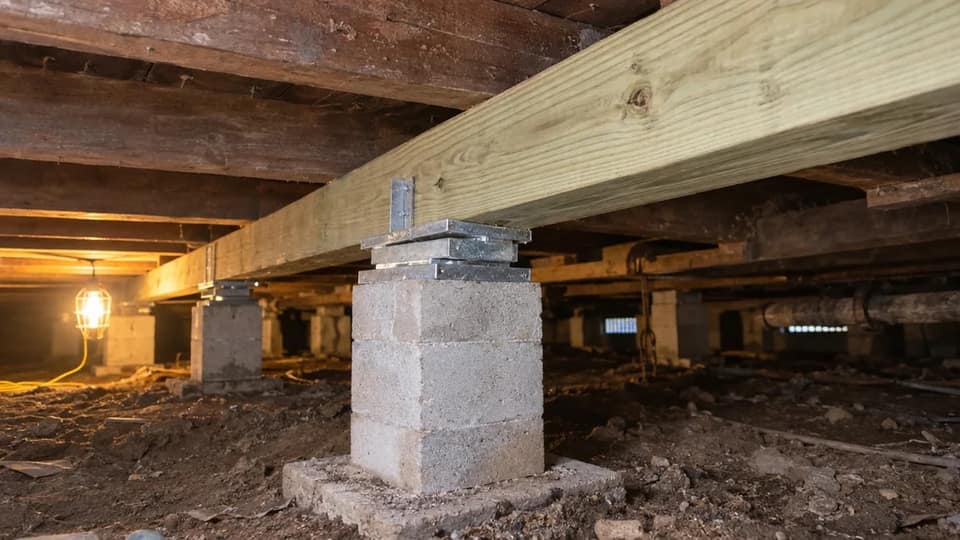
New Braunfels was laid out in 1845, and the Downtown, Mill Street, Sophienburg Hill and Stock historic districts hold houses from the German fachwerk period through the Craftsman bungalows of the 1920s. Almost all of them are pier and beam: a wood floor system on beams, carried on cedar posts, stacked concrete blocks, brick piers or shallow poured pads, with a crawlspace of a foot or two beneath.
Gruene, annexed into the city in 1979, has the 1872 Gruene Mansion and the frame houses around Gruene Hall. Seguin's downtown around the courthouse square has Victorians and Craftsmans on pier and beam, and San Marcos has the Belvin Street district and the older blocks around Texas State. Farther out, the farmhouses along FM 725 and FM 1101 and the lake cabins at Canyon Lake from the 1960s and 70s are mostly pier and beam too.
Many of these houses have been added onto. A 1920s core on cedar posts with a 1970s addition on a slab is a common configuration, and the joint between the two is where the trouble shows.
What goes wrong under an old house
Four things, mostly. The ground under the posts moves, especially on the clay in Seguin and east New Braunfels, so posts tilt or sink and the floor above them dips. Wood rots where it touches soil or stays damp, so cedar posts lose their bottoms and sills and rim joists soften, particularly on the shaded north side and under bathrooms. Beams sag between supports that were spaced too far apart to begin with, often ten or twelve feet when six to eight is right. And past owners made field repairs with whatever was handy, so you find car jacks, stacked bricks, and 2x4s doing structural work.
Symptoms upstairs: floors that slope toward the middle of a room or bounce when you walk, doors that swing on their own, a gap under baseboards, cracked plaster at the corners of door frames, and a line of stuck windows along one wall.
Plumbing is the other factor. A slow drain leak under a pier and beam house saturates the clay under a few posts and they sink. The crawlspace at least makes the leak visible and fixable without breaking concrete.
How pier and beam repair is done
The technician gets in the crawlspace with a light and a probe and maps every support: what it is made of, whether it is plumb, whether the wood above it is sound. Floor elevations get shot from above. Then a plan.
Shimming and re-leveling: the beam is jacked gently off the post, steel or hardwood shims are set on top of the post or pad, and the beam comes back down level. This corrects the sag where the supports are sound but have settled a little.
New supports: where posts have rotted or sunk, or where beams are overspanned, new concrete pads are set on compacted soil or, better, pressed concrete piers are installed under the beam line and capped with a steel or treated-wood post. Pads every six to eight feet along each beam is the usual target.
Sister beams and joist repair: a sagging or split beam gets a new treated beam bolted alongside it, carried on the same supports. Rotted sills and rim joists are cut out and replaced in sections with the wall temporarily supported. Rotted floor joists get sistered or replaced.
Moisture control: the job is not done until the reason the wood rotted is addressed. That means grading water away from the house, adding or clearing crawlspace vents, fixing the plumbing leak and, in wet crawlspaces, a vapor barrier over the soil.
What pier and beam repair costs
A straightforward shim and re-level of a few sagging areas, with sound wood and sound supports, often runs $1,500 to $4,000. Adding new pads or piers and a handful of posts pushes it to $4,000 to $8,000. Jobs with significant sill, beam or joist replacement, or a full re-support of the house, run $8,000 to $15,000 and up on larger homes.
Crawlspace access matters. A house with eighteen inches of clearance costs more to work under than one with three feet, and a house with no access hatch needs one cut.
Historic district homes in New Braunfels may need a certificate of appropriateness for exterior changes like skirting or vents. Structural work underneath is generally not visible and not restricted, but confirm with the city's planning department before touching anything you can see from the street.
Related services
Foundation Repair in New Braunfels and Comal County
A straight explanation of how a Central Texas foundation gets diagnosed and fixed, what it costs, and when you should wait.
Slab Foundation Repair in New Braunfels
Nearly every home built in Comal County since the 1970s sits on a slab. Here is how a settled slab gets underpinned, and which pier makes sense on which side of I-35.
House Leveling in New Braunfels
Leveling is the part of foundation repair homeowners picture: jacks under the house, the low corner coming back up. Here is what that actually involves and what it can realistically recover.
Drainage Correction and Foundation Protection
Piers fix what already moved. Drainage is what keeps the next section of the house from moving. On Comal County clay, it is not optional.
Foundation Inspection in New Braunfels
A foundation inspection is a set of measurements and a walk-around by someone who has seen a thousand Comal County slabs. Here is what it covers, what it does not, and when you need an engineer instead.
Foundation Crack Repair in New Braunfels
Every brick house in Comal County has a crack somewhere. The job is telling the ones that mean the soil is moving the house from the ones that just mean it is a brick house in Texas.
Questions homeowners ask
Can a pier and beam house be converted to a slab?
Not practically. You would be building a new foundation under a standing house. The better path is to re-support the existing system properly. A well-maintained pier and beam house is easier and cheaper to adjust over its life than a slab.
How often does a pier and beam house need adjusting?
On the clay around Seguin and east New Braunfels, a touch-up shim every ten to fifteen years is normal. On the limestone side it can go decades. Rotted wood is a one-time fix if the moisture problem is solved.
Should the old cedar posts be replaced?
Cedar heartwood in dry soil lasts a very long time, and plenty of 1920s posts in the Sophienburg Hill district are still sound. Posts with soft bottoms, posts that have shifted off their footing, and posts carrying a sagging beam should be replaced with a concrete pad or pier and a treated or steel post.
What about the brick skirting around the house?
Skirting is cosmetic and is not carrying the house. It often cracks when the floor system is re-leveled because the house moves and the skirting does not. Budget for some mortar repair after the lift.
Is a vapor barrier in the crawlspace a good idea here?
In a crawlspace that stays damp, yes. In a well-ventilated crawlspace over limestone that is dry nine months a year, it is less important. The technician will tell you which you have.
Service area
Comal, Guadalupe and Hays County homes, roughly a 35 mile ring around New Braunfels.
Get someone under the house who knows old houses
Call (830) 626-9042. We route you to a licensed, insured contractor who works the historic districts in New Braunfels and Seguin.
Calls may be recorded for quality and training. Your details go only to the contractor who will serve you. How this works