Slab Foundation Repair in New Braunfels
Nearly every home built in Comal County since the 1970s sits on a slab. Here is how a settled slab gets underpinned, and which pier makes sense on which side of I-35.
Mon to Sat 7am to 7pm. Calls answered, not voicemail.
How a slab fails in Central Texas
A slab-on-grade foundation is a monolithic pour, usually four inches thick in the field with thickened grade beams around the perimeter and under load-bearing walls. Most slabs in New Braunfels built after about 1990 are post-tensioned, with steel cables stressed after the pour. Older slabs are conventionally reinforced with rebar.
Slabs fail at the edges. The perimeter is where the soil dries fastest, where downspouts dump, where the lawn gets watered and where tree roots feed. On the Blackland clay east of I-35, the soil under the slab edge can lose enough volume in a dry summer to drop the perimeter grade beam an inch or more while the center, insulated by the house itself, stays where it was. That is edge settlement, and it is the most common call in Westpointe, Mission Hills, Creekside and the FM 1101 subdivisions.
The reverse also happens. Heavy watering or a plumbing leak under the slab can swell the clay and heave the center upward, cracking tile along a ridge down the hall. Center heave needs the water source fixed first. Piers do not fix heave.
On the limestone side, in Oak Run, Rockwall Ranch, River Chase and toward Spring Branch, slabs are often partly on rock and partly on fill. The fill side settles, the rock side does not, and a diagonal crack opens at the transition.
Pressed concrete piers
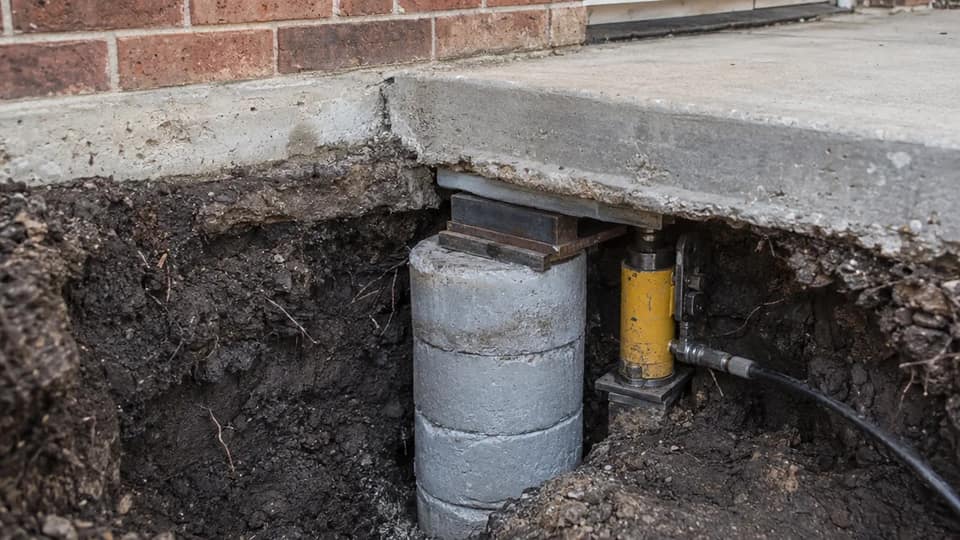
This is the standard repair for a settled slab edge in the New Braunfels market. A crew digs a hole about two feet square and three feet deep at the slab edge, undercutting the grade beam. A hydraulic ram braced against the beam presses a precast concrete cylinder straight down into the soil. Another cylinder goes on top, and another, until the stack hits refusal, meaning the ram cannot push it any deeper at the rated pressure.
On the east side of town refusal typically comes between eight and fourteen feet, where the clay turns stiff and stays moist year round. On the west side it can come at four feet when the stack hits limestone. Either way, the pier now bears on ground that does not move with the weather. A concrete cap, steel shims and sometimes a block go between the pier top and the grade beam, and the house is lifted with bottle jacks across all the piers at once.
Pressed concrete piers cost roughly $400 to $800 each installed in this area. They are proven, fast, and appropriate for most one and two-story homes on the clay. Their limitation is that the stack is only as straight as the soil lets it be, and in very soft or wet soil a tall stack can drift.
Steel piers
Steel piers are installed the same way but use sections of steel pipe, often three inches in diameter, driven with the weight of the house as the reaction. They go deeper than concrete, commonly twenty to thirty feet and sometimes farther, and they carry more load per pier. The sections lock together so the pier stays plumb.
They make sense on heavy two-story brick homes, on lots where the active clay is deep, and anywhere an engineer wants a pier that bears below any zone of seasonal moisture change. Cost runs about $1,200 to $3,000 per pier. Warranties on steel piers in this market are commonly lifetime and transferable.
Helical piers, a steel shaft with screw plates turned into the ground with a torque motor, are a cousin of the pushed steel pier. They are used when the structure is too light to provide reaction for a pushed pier, such as a porch or a detached garage.
Drilled bell-bottom piers
A drilled pier is poured in place. A rig drills a shaft, usually ten to twelve inches in diameter and ten to fourteen feet deep, then a belling tool widens the bottom into a cone for bearing area. A rebar cage goes in and concrete is poured. After the concrete cures, typically seven days or more, the house is lifted onto the new pier.
Drilled piers are what most Central Texas engineers specify on new construction, and some engineers specify them for repairs because the bell gives a large bearing footprint in clay. They take longer, need rig access, and cost more than pressed concrete. They are less common for retrofit work on tight suburban lots in Veramendi or Westpointe and more common on acreage lots where the rig can reach every side of the house.
Interior piers and slab lifting
When the elevation survey shows the interior has dropped, not just the edge, the fix is interior piers. The crew cuts a two-by-two-foot hole through the slab in the low room, tunnels or digs down to the grade beam, presses a pier, lifts, and patches the concrete. Flooring in that spot has to come up and be replaced. Nobody enjoys this, but it is the only way to support a dropped interior beam.
For a slab that has a void under it but has not structurally dropped, polyurethane foam injection through small holes can fill the void and lift the slab a fraction of an inch. It is a good fit for garage slabs and patios and a poor fit for perimeter grade beams.
Every lift should be preceded and followed by a plumbing test. Drain lines under a slab are cast iron or PVC and they do not enjoy being moved two inches.
Related services
Foundation Repair in New Braunfels and Comal County
A straight explanation of how a Central Texas foundation gets diagnosed and fixed, what it costs, and when you should wait.
Pier and Beam Foundation Repair
The 1890s to 1950s houses on Mill Street, Academy Avenue, Hunter Road and around the Seguin courthouse square sit on posts and beams. They are fixed from underneath, and done right they outlast the slab homes around them.
House Leveling in New Braunfels
Leveling is the part of foundation repair homeowners picture: jacks under the house, the low corner coming back up. Here is what that actually involves and what it can realistically recover.
Drainage Correction and Foundation Protection
Piers fix what already moved. Drainage is what keeps the next section of the house from moving. On Comal County clay, it is not optional.
Foundation Inspection in New Braunfels
A foundation inspection is a set of measurements and a walk-around by someone who has seen a thousand Comal County slabs. Here is what it covers, what it does not, and when you need an engineer instead.
Foundation Crack Repair in New Braunfels
Every brick house in Comal County has a crack somewhere. The job is telling the ones that mean the soil is moving the house from the ones that just mean it is a brick house in Texas.
Questions homeowners ask
Which pier is right for my house?
For most one-story slabs on the clay east of I-35, pressed concrete piers are the right call on cost and performance. For heavy two-story homes, deep active clay, or anything an engineer has designed, steel is worth the extra cost. Drilled piers are usually an engineer's specification rather than a homeowner's choice.
How many piers will I need?
Piers go roughly every six to eight feet along the settled section of the perimeter, plus any interior supports that have dropped. A single settled corner might take four to six piers. A full side of the house might take ten to twelve. The elevation survey determines the count.
Will the slab crack during the lift?
Existing cracks usually close partly during the lift. New cracking is uncommon when the lift is done gradually across all piers at once, but a slab that has been bent for years has some permanent set, and brick that has adjusted to the low position may open a new hairline at the top of the wall.
Does the warranty cover the whole house?
Pier warranties cover the piers that were installed. If a section of the house that was not piered settles later, that is a new job. Ask the contractor to mark the warranty area on the pier plan so there is no argument later.
Can I stay in the house during the work?
Yes for exterior pier work. Water may be off for a few hours during the plumbing test. For interior piers in a bedroom or living area, plan to have that room out of service for a few days.
My house is only eight years old. Why is the slab moving?
Newer subdivisions on the east side were farmland for a century, and the clay under them has never had a roof over it until now. The first few drought cycles after construction are when the soil under a new slab finds its new moisture equilibrium, and that is often when the first cracks show.
Service area
Comal, Guadalupe and Hays County homes, roughly a 35 mile ring around New Braunfels.
Find out which pier your slab actually needs
Call (830) 626-9042. A licensed, insured contractor takes elevations and gives you a pier plan with a per-pier price.
Calls may be recorded for quality and training. Your details go only to the contractor who will serve you. How this works