Foundation Crack Repair in New Braunfels
Every brick house in Comal County has a crack somewhere. The job is telling the ones that mean the soil is moving the house from the ones that just mean it is a brick house in Texas.
Mon to Sat 7am to 7pm. Calls answered, not voicemail.
Reading brick cracks
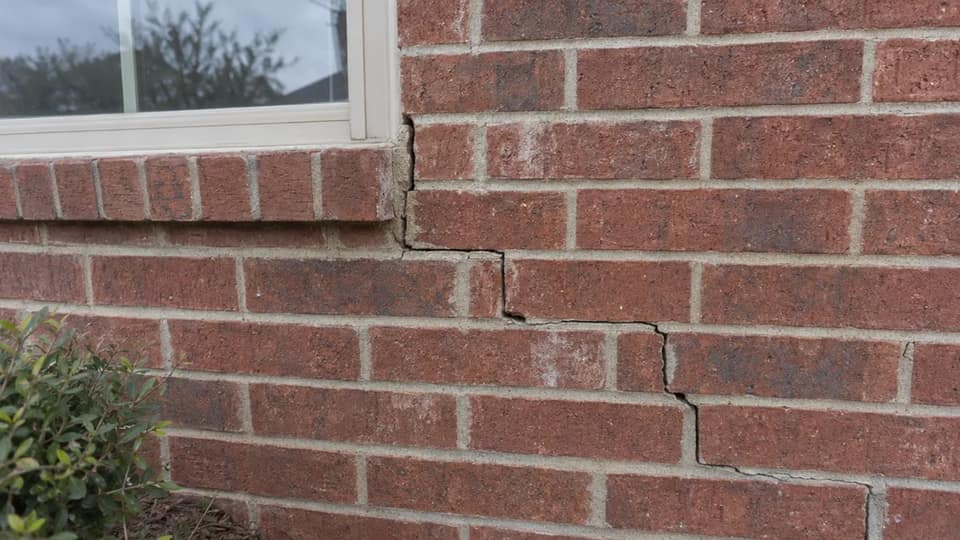
Brick veneer is a stiff skin on a house that moves, so it cracks first and tells the story best. The pattern matters more than the crack itself.
Stair-step cracks following the mortar joints diagonally, widening toward the top of the wall or toward one end, are the classic sign of a settled corner or edge. The brick is pulling apart because the foundation under one end has dropped. If the steps are wider than a quarter inch, if the crack has opened since you last looked, or if there is a matching crack on the inside drywall, the foundation is moving and the crack is a symptom.
Vertical cracks running straight through brick and mortar in a line usually mean the wall is too long without a control joint and has cracked from thermal expansion. Common on long garage walls facing west. Usually cosmetic.
Horizontal cracks along a mortar bed, especially near the top of a wall under the soffit, point to the frieze board separating as the wall tilts or the lintel over a wide opening deflecting. Worth having looked at.
A gap opening between the brick and a window or door frame on one side of the house only, with the caulk torn, is a rotation sign and goes with a settled edge.
Drywall and interior cracks
Diagonal cracks running from the upper corners of door and window openings are the interior twin of stair-step brick cracks. The opening is the weak point in the wall, and when the wall racks from foundation movement the crack starts there. One or two in a twenty-year-old house are normal; a cluster on one side of the house with doors sticking is not.
Cracks along the tape joints between drywall sheets, straight and running vertically or horizontally, are usually tape failure or framing shrinkage. Cracks at the ceiling-wall joint on an exterior wall can be truss uplift, a roof framing phenomenon, not the foundation. Nail pops are framing.
On a pier and beam house, cracks in plaster at door corners plus a sloping floor point to a settled or rotted support below that spot.
Slab cracks
A hairline crack running across a garage slab or showing through the tile in a straight line is almost always a shrinkage crack from the original cure. Concrete shrinks as it dries and cracks somewhere. These are cosmetic.
A slab crack where one side is higher than the other, where the crack is wider than an eighth of an inch and growing, or where a ridge has formed under the tile or carpet, is a structural crack. The slab has bent, either because an edge dropped or because the center heaved. On the clay east of I-35, center heave from a plumbing leak or heavy watering produces a long crack down the middle of the house with the tile tented along it.
Cracks at the slab edge visible from outside, especially at a corner, with the brick above also cracked, indicate the grade beam has cracked from settlement.
How cracks are repaired
Structural cracks are not repaired directly. The cause is. Piers are installed under the settled section and the house is lifted, which closes most of the crack. Once the house is stable, the crack itself gets cosmetic treatment.
Brick: cracked mortar joints are ground out and tuck-pointed with matching mortar. Cracked bricks are cut out and replaced. On a good match the repair disappears in a year of weather. Tuck-pointing a typical stair-step crack runs a few hundred dollars; a mason does this, not the foundation crew.
Drywall: the crack is cut back, taped with mesh, floated, textured and painted. Wait two to four weeks after a lift.
Slab: structural cracks in the slab, after the house is stabilized, can be filled with epoxy injection to restore the concrete's continuity and keep moisture out. Shrinkage cracks in a garage can be left alone or sealed with a flexible polyurethane sealant. Epoxy injection runs roughly $250 to $800 per crack.
Cracks that leak water into a living space are a separate issue and usually a drainage problem first.
Related services
Foundation Repair in New Braunfels and Comal County
A straight explanation of how a Central Texas foundation gets diagnosed and fixed, what it costs, and when you should wait.
Slab Foundation Repair in New Braunfels
Nearly every home built in Comal County since the 1970s sits on a slab. Here is how a settled slab gets underpinned, and which pier makes sense on which side of I-35.
Pier and Beam Foundation Repair
The 1890s to 1950s houses on Mill Street, Academy Avenue, Hunter Road and around the Seguin courthouse square sit on posts and beams. They are fixed from underneath, and done right they outlast the slab homes around them.
House Leveling in New Braunfels
Leveling is the part of foundation repair homeowners picture: jacks under the house, the low corner coming back up. Here is what that actually involves and what it can realistically recover.
Drainage Correction and Foundation Protection
Piers fix what already moved. Drainage is what keeps the next section of the house from moving. On Comal County clay, it is not optional.
Foundation Inspection in New Braunfels
A foundation inspection is a set of measurements and a walk-around by someone who has seen a thousand Comal County slabs. Here is what it covers, what it does not, and when you need an engineer instead.
Questions homeowners ask
How wide does a crack have to be before I should worry?
A quarter inch in brick or an eighth inch in a slab, or any crack that has visibly grown in the past year. Width matters less than change. Put a pencil mark at the end of a crack with the date and check it in six months.
Can I just caulk the brick crack?
You can keep water out of it with a color-matched sealant, and that is worth doing. It does not fix anything if the foundation is still moving, and it makes it harder for an inspector to see what is happening later. Mark the ends before you fill it.
My new house has cracks. Is the builder responsible?
Most Texas builders warrant the structure for ten years and cover foundation movement beyond a stated tolerance, often defined in the warranty documents in inches of deflection. Hairline cracks in the first two summers are expected. Document them with dates and photos and get the warranty terms in front of you.
Will the stair-step cracks close after piers?
Usually most of the way. A crack that was a quarter inch may close to a hairline as the corner lifts. Brick that was already tuck-pointed in the low position will not close and may open a new hairline at the top.
Is a crack in the garage slab a foundation problem?
Rarely. Garage slabs are thinner, carry less load, and crack from shrinkage and vehicle weight. A garage slab that has dropped away from the house slab at the threshold is different and worth a look.
Service area
Comal, Guadalupe and Hays County homes, roughly a 35 mile ring around New Braunfels.
Have the crack read by someone who sees them every day
Call (830) 626-9042. A licensed, insured contractor tells you whether it is cosmetic or structural and what, if anything, it needs.
Calls may be recorded for quality and training. Your details go only to the contractor who will serve you. How this works