Drainage Correction and Foundation Protection
Piers fix what already moved. Drainage is what keeps the next section of the house from moving. On Comal County clay, it is not optional.
Mon to Sat 7am to 7pm. Calls answered, not voicemail.
The clay cycle that drives everything
Houston Black clay, the Texas state soil and the ground under most of New Braunfels east of I-35, can change volume dramatically with moisture. Swell it with a wet spring and it pushes up. Dry it through a July and August with no rain and it shrinks and cracks, sometimes leaving a gap between the dirt and the slab edge you can put your hand into. A foundation sitting on that soil rides up and down with it.
Uniform movement is tolerable. A house that rises and falls evenly does not crack. The damage comes from differential movement: one side of the house wet from a leaking downspout while the other side bakes, or the south side shaded and damp while a live oak drinks the north side dry. Drainage correction is about making the moisture under the slab as even and as steady as possible.
Two local patterns are worth knowing. The first is the drought-then-flood swing. New Braunfels sat in Stage 3 water restrictions for nearly a year in 2022 and 2023, and the Guadalupe and Comal river basins are known for fast, heavy rain events. Clay that has shrunk hard and then floods swells fast and unevenly. The second is new construction on old farmland. Subdivisions east of the highway were cotton and sorghum fields, and the clay under them is deep and undisturbed.
Surface grading and gutters
The cheapest fix is the first one to check. Soil should fall away from the slab at roughly six inches over the first ten feet. Most houses in Westpointe and Mission Hills were built that way, and most have lost it to twenty years of mulch beds, settled backfill and landscape edging that traps water against the brick. Regrading the perimeter and pulling flowerbed borders back a few inches fixes a surprising share of wet-side problems.
Gutters matter on clay. A roof valley dumping thousands of gallons a year at one corner saturates that corner and nothing else. Downspouts should discharge at least five feet from the slab, either on splash blocks over properly graded soil or into buried pipe that daylights downhill or ties to a drain. Gutter and downspout work, including extensions and buried leaders, typically runs a few hundred to a couple thousand dollars.
Sprinkler heads spraying the foundation and drip lines that have been cut are the other common culprit. Check them before anything else.
French drains and surface drains
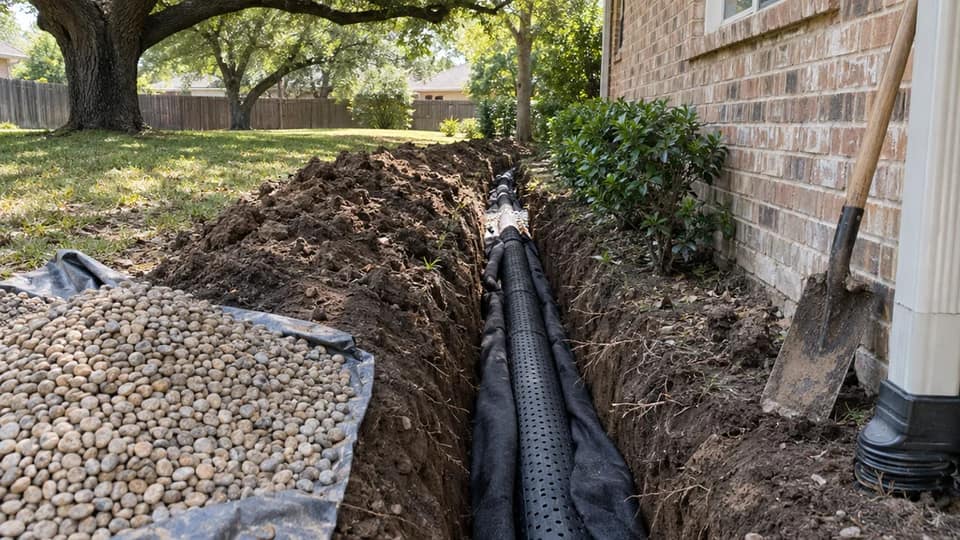
When grading alone cannot move the water, a French drain does it underground. A trench twelve to eighteen inches deep is cut along the wet side of the house, a few feet off the slab, lined with filter fabric, and filled with gravel around a perforated pipe that slopes to a discharge point. Water in the soil enters the pipe and leaves. On the clay side, French drains are most useful along a side yard that collects runoff from a neighbor's lot or along the uphill side of a house on a sloped street.
Surface or area drains with grates catch sheet flow in low spots and patios and carry it through solid pipe. Combined systems with downspouts tied in are common.
French drain installation in this area typically runs $25 to $60 per linear foot depending on depth, access and the discharge, so a sixty-foot run along one side of a house is often $1,500 to $4,000. Full-perimeter drainage with multiple discharge points runs more. The contractor will tell you whether the lot has somewhere for the water to go; on a flat east-side lot that is sometimes the hard part.
Root barriers and trees
Live oaks, cedar elms and hackberries are everywhere in New Braunfels, and a mature tree within fifteen feet of a slab pulls a great deal of water out of the clay on that side every summer. The fix is not to cut the tree. It is a root barrier: a trench cut between the tree and the house, usually thirty to forty-eight inches deep, with a solid barrier panel installed vertically. Roots are pruned at the trench and redirected downward and away.
Root barriers run roughly $50 to $100 per linear foot installed. They are most effective when installed before the tree has done serious damage, and they pair well with piers on the affected side.
Soaker hose watering
The homeowner's job on the clay side is to keep the soil moisture around the slab steady through the dry months. A soaker hose laid twelve to eighteen inches out from the slab edge, run thirty to forty-five minutes three or four mornings a week during drought, keeps the perimeter soil from shrinking away from the beam. The goal is damp, not puddled. Watch the gap between the soil and the slab; if you can see one, you are behind.
On the limestone side of town, with a foot of soil over rock, this matters much less. Know which side you are on.
Related services
Foundation Repair in New Braunfels and Comal County
A straight explanation of how a Central Texas foundation gets diagnosed and fixed, what it costs, and when you should wait.
Slab Foundation Repair in New Braunfels
Nearly every home built in Comal County since the 1970s sits on a slab. Here is how a settled slab gets underpinned, and which pier makes sense on which side of I-35.
Pier and Beam Foundation Repair
The 1890s to 1950s houses on Mill Street, Academy Avenue, Hunter Road and around the Seguin courthouse square sit on posts and beams. They are fixed from underneath, and done right they outlast the slab homes around them.
House Leveling in New Braunfels
Leveling is the part of foundation repair homeowners picture: jacks under the house, the low corner coming back up. Here is what that actually involves and what it can realistically recover.
Foundation Inspection in New Braunfels
A foundation inspection is a set of measurements and a walk-around by someone who has seen a thousand Comal County slabs. Here is what it covers, what it does not, and when you need an engineer instead.
Foundation Crack Repair in New Braunfels
Every brick house in Comal County has a crack somewhere. The job is telling the ones that mean the soil is moving the house from the ones that just mean it is a brick house in Texas.
Questions homeowners ask
Can drainage work alone fix my foundation problem?
If the elevation survey shows the house within tolerance and the cracks are minor and stable, yes, and the contractor should say so. If a section has already dropped more than an inch, drainage keeps it from getting worse but does not lift it back.
Do I need a French drain or just better gutters?
Start with gutters, downspout extensions and grading. Most wet-side problems in New Braunfels subdivisions are solved there. A French drain is for water arriving through the soil from somewhere you cannot regrade, like a neighbor's lot or an uphill street.
How deep should a root barrier be?
Thirty to forty-eight inches is typical here. Live oak feeder roots are mostly in the top two to three feet, so a barrier in that range intercepts the bulk of them.
Should I water my foundation in winter?
Rarely. Central Texas winters are usually damp enough. The watering season on the clay side runs roughly June through September, and longer in a drought year.
Where does the water from a French drain go?
To the lowest point on your lot that is away from the house, to the street curb through a sleeve where the city allows it, or to a dry well on flat lots. Discharging onto a neighbor's property is not an option.
Service area
Comal, Guadalupe and Hays County homes, roughly a 35 mile ring around New Braunfels.
Fix the water before you buy piers you may not need
Call (830) 626-9042. A licensed, insured contractor looks at grading, gutters and trees as part of every foundation inspection.
Calls may be recorded for quality and training. Your details go only to the contractor who will serve you. How this works