Foundation Repair in Schertz and Cibolo, Texas
Schertz and Cibolo went from farm towns to 75,000 people in about twenty-five years, and most of those homes are slabs on Blackland clay along Cibolo Creek. The first wave of them is now old enough to show it.
Mon to Sat 7am to 7pm. Calls answered, not voicemail.
Where the ground changes in Schertz and Cibolo
Schertz is one of the few cities in Texas that sits in three counties: Guadalupe, Bexar and Comal. Cibolo is almost entirely in Guadalupe County with a sliver in Bexar, on the north bank of Cibolo Creek. Nearly all of both cities is on the Blackland Prairie, the same Houston Black and Heiden clay that runs from Seguin up to the east side of New Braunfels. It is black, sticky when wet, cracks into plates when dry, and moves a slab with every swing.
The exception is the north end. Up FM 3009 past Northcliffe toward Garden Ridge, and along the Comal County line, the clay thins over limestone and the ground gets more calcareous and stable. A house in Scenic Hills near I-35 and a house in Northcliffe three miles north can behave differently, and the one in Northcliffe is usually the calmer of the two.
Cibolo Creek itself cuts through both cities and brings its own soil. The terraces along the creek, through Schertz's older core near Main Street and FM 78, and down through Cibolo toward FM 1103, carry alluvial clay and gravel that can be loose and inconsistent. Older homes near the creek sometimes have settlement that has nothing to do with drought and everything to do with what was under the slab when it was poured.
Cibolo: from 3,000 people to 32,000 in twenty years
Cibolo had about 3,000 residents in 2000 and over 32,000 by 2020. Almost every one of those new homes is a production slab poured on former cotton and sorghum ground along FM 1103, FM 78 and the new arterials toward I-10. Steele Creek, Buffalo Crossing, Saddle Creek Ranch, Mesa at Turning Stone and the neighborhoods around Steele High School are the result.
Slabs poured on clay that was farmed for a century go through an adjustment period of roughly five to fifteen years. The soil under the middle of the house dries out slowly to a steady level because rain no longer reaches it. The perimeter keeps cycling with the weather. The edges drop relative to the center, and the first signs are stair-step cracks in the brick over the patio door, a back bedroom door that sticks from July to October, and hairline cracks at the top corners of windows on the side of the house facing the drainage easement.
The 2005 to 2012 phases in Cibolo are in the thick of that window now, and the 2015 to 2020 phases are entering it. Builder structural warranties in Texas commonly run ten years, so for a lot of Cibolo homes the clock is a factor. Get an elevation survey before the warranty ends, not after.
Schertz: Northcliffe, Scenic Hills, Crossvine and the older core
Schertz has a wider spread of housing ages than Cibolo. The core near Main Street and FM 78 dates to the railroad town of the early 1900s and has pier and beam houses and 1950s and 60s slabs. Scenic Hills, off I-35 between Schertz and Live Oak, is 1980s and 90s ranch-style brick on slabs that have been through thirty-plus drought cycles. Northcliffe, the golf course community at the north end along I-35 and FM 3009, is 1970s through 1990s, and benefits from the shallower soil up there. The Crossvine, off FM 1518 on the south side toward Randolph, is 2010s and 2020s master-planned construction on deep clay.
The thirty-year-old slabs in Scenic Hills and the FM 3009 corridor are the ones most likely to have been repaired before. Prior piers are not a problem if there is paperwork and a transferable warranty. Prior piers with no paperwork, and fresh paint on one side of the brick, deserve a careful elevation survey before purchase.
Randolph Air Force Base means Schertz and Cibolo have a steady flow of military families buying and selling on short timelines, often with VA financing. VA appraisers routinely call for an engineer's letter when they see foundation cracking, and that can stall a closing by weeks. Sellers who know their slab has moved are better off getting the engineer's report and, if needed, the repair done with a transferable warranty before listing.
Repairs that fit this ground
On the Blackland clay through most of Schertz and Cibolo, pressed concrete piers are the standard, typically refusing between ten and sixteen feet. Steel piers are specified on heavy two-story homes, which Crossvine and Steele Creek have plenty of, and where an engineer wants bearing below the full depth of seasonal moisture change. Pier counts of eight to fifteen for a partial perimeter repair are typical, with full-perimeter jobs on larger homes running higher.
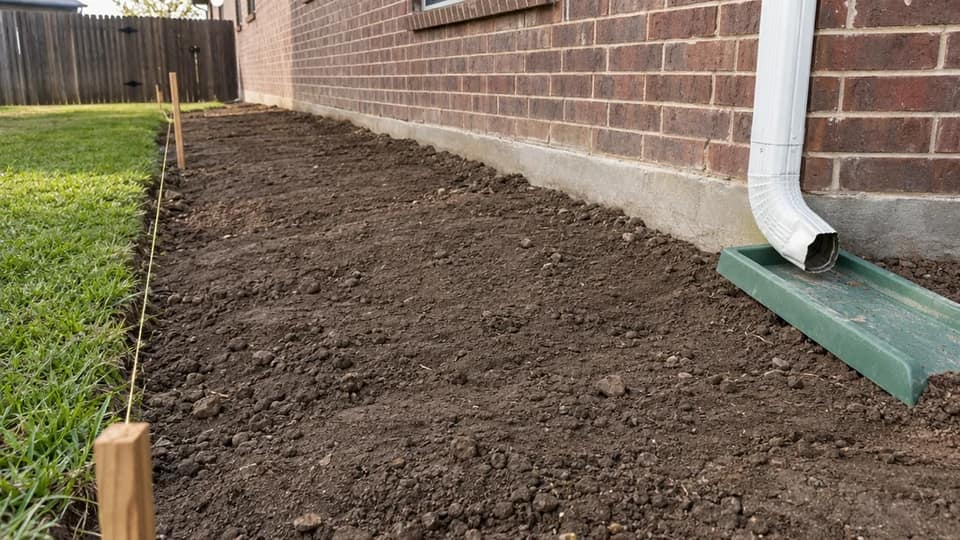
Drainage work is a bigger part of the job here than in New Braunfels proper because the lots are flat. Backyards in Cibolo subdivisions often fall only a few inches to a drainage easement at the back fence, and a few seasons of mulch and landscaping can reverse that fall toward the house. Regrading, downspout extensions and, where needed, a French drain along the wet side protect the pier investment.
On the north end near Garden Ridge and in Northcliffe, piers often hit limestone refusal at four to eight feet, jobs go faster, and the typical problem is a fill pocket under one corner rather than clay movement around the whole house.
Questions homeowners ask
What does foundation repair cost in Schertz and Cibolo?
Pressed concrete piers run about $400 to $800 each installed and steel piers $1,200 to $3,000. Most slab repairs in Cibolo and Schertz land between $4,000 and $15,000. Drainage corrections, which are common add-ons on flat lots here, run $1,500 to $5,000.
My Cibolo house is nine years old. Should I call the builder or a repair contractor?
Get the elevation survey first. It takes an hour and gives you numbers. If the house is outside the deflection tolerance in your builder's structural warranty, that survey is what you bring to the builder. If it is inside tolerance, you know to focus on drainage and watering and recheck in a year.
Is Northcliffe really more stable than the rest of Schertz?
Generally, yes. The soil thins over limestone toward the Comal County line and piers refuse shallower. Northcliffe homes still have foundation issues, but they are more often fill settlement or a plumbing leak than the broad clay movement seen along FM 1103 or FM 1518.
We are selling with a VA buyer and the appraiser flagged cracks. What now?
A licensed professional engineer's inspection and letter, typically $350 to $700, is what the lender wants. If the engineer finds the house within tolerance, the letter clears it. If repair is needed, the contractor performs it to the engineer's plan and the engineer issues a completion letter. The contractor we route calls to does this regularly for Randolph-area closings.
Does Schertz or Cibolo require a permit?
Both cities require a permit for foundation repair, and the contractor pulls it. Schertz properties in the Bexar or Comal County portions follow the city's process regardless of county.
Do the homes along Cibolo Creek flood, and does that affect the foundation?
Lots in the Cibolo Creek floodplain are mapped and most newer homes are built above it. The foundation concern near the creek is the alluvial soil, which can be loose and variable, rather than the water itself. An elevation survey before purchase is a cheap way to check.
Service area
Comal, Guadalupe and Hays County homes, roughly a 35 mile ring around New Braunfels.
Foundation repair in Schertz and Cibolo, on a military timeline if you need it
Call (830) 626-9042 Monday through Saturday. We route your call to a licensed, insured foundation contractor serving Guadalupe, Bexar and Comal Counties.
Calls may be recorded for quality and training. Your details go only to the contractor who will serve you. How this works