Foundation Inspection in New Braunfels
A foundation inspection is a set of measurements and a walk-around by someone who has seen a thousand Comal County slabs. Here is what it covers, what it does not, and when you need an engineer instead.
Mon to Sat 7am to 7pm. Calls answered, not voicemail.
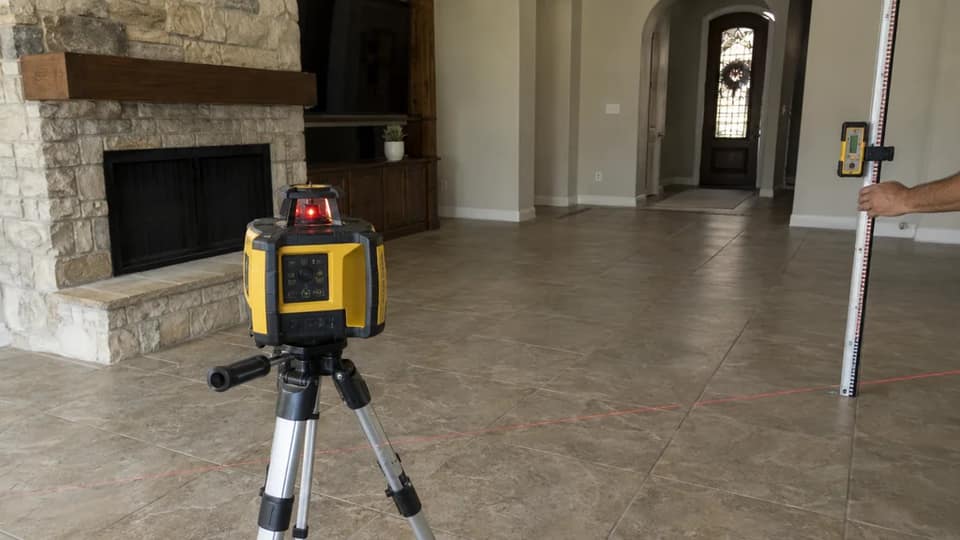
What the contractor's inspection covers
The core of the inspection is a relative elevation survey. The technician sets up a laser level or a zip level inside the house and takes floor readings on a grid, generally every eight to ten feet, in every room and the garage. The readings go on a sketch of the floor plan. The result is a contour of the slab: where it is high, where it has dropped, and by how much.
Outside, they walk the full perimeter and document brick and mortar cracks, their width and pattern, separation at window and door frames, gaps at the frieze board and soffit, the condition of the slab edge, and how far the soil has pulled away from it. They note the grade, where downspouts discharge, sprinkler coverage, and every tree within about fifteen feet of the house.
Inside, they check door and window operation, cracks at drywall corners, tile and grout cracks, and any sign of plumbing trouble like a warm spot on the floor or a musty closet. On a pier and beam house they go into the crawlspace and probe the wood.
You get a sketch with the elevation readings, a description of what was found, and if repair is recommended, a pier plan with a count and a price. If the house is within normal tolerance, you get told that.
When an engineer's report is the right call
Texas does not license foundation repair contractors, so the contractor's inspection is an experienced opinion, not a professional certification. For most repair decisions on a home you plan to keep, that is sufficient. For several situations it is not.
Real estate transactions. A buyer's TREC-licensed home inspector is required to render a written opinion on foundation performance based on what they can see, and when they note signs of adverse performance they commonly recommend evaluation by a licensed professional engineer. Lenders, and especially FHA and VA underwriters, often require an engineer's letter before they will fund a loan on a house with noted foundation movement. Sellers in New Braunfels frequently commission one up front to keep a deal from stalling.
Disputes and prior repairs. If a previous repair has failed, if there is a warranty claim, or if a builder is involved on a newer home in Veramendi or Meyer Ranch, you want an independent engineer who has no stake in selling piers.
Complex structures. Large two-story homes, homes with significant interior settlement, homes on steep Canyon Lake lots with retaining walls, and homes with both slab and pier and beam sections benefit from an engineered repair plan.
The engineer takes their own elevations, reviews the soil conditions, and issues a signed and sealed report with findings and, if needed, a repair specification: pier type, depth, spacing and location. After the work, the engineer can return and issue a letter confirming the repair was performed to the plan. Engineer reports in this area typically run $350 to $700, with post-repair letters extra.
How the contractor and engineer work together
The cleanest arrangement is one where the homeowner hires the engineer directly, the engineer writes the plan, and the contractor bids and builds to it. The contractor we route calls to works this way regularly and can give you names of licensed professional engineers in the New Braunfels and San Antonio area, but you are not required to use them and the engineer is not paid by the contractor.
Be cautious of a repair company whose in-house engineer both diagnoses the problem and designs a repair that only that company performs. It is legal, but it is not independent.
Inspecting a house you are about to buy
Comal County has a lot of homes changing hands, and a lot of them have some movement. The questions that matter: Is the movement active or old? Is it within normal tolerance for a house of that age on that soil? Has it been repaired before, by whom, and is the warranty transferable? Is there a plumbing leak driving it?
A foundation contractor's inspection answers the first two quickly. An engineer answers them with a signed document the lender will accept. A hydrostatic plumbing test answers the last one and is worth the few hundred dollars on any east-side slab with cracks.
Ask the seller for the pier plan and warranty paperwork on any prior repair. A house in Westpointe with twelve piers on the north side and a transferable lifetime warranty is a better buy than the same house with no paperwork and a fresh coat of paint on the brick.
Related services
Foundation Repair in New Braunfels and Comal County
A straight explanation of how a Central Texas foundation gets diagnosed and fixed, what it costs, and when you should wait.
Slab Foundation Repair in New Braunfels
Nearly every home built in Comal County since the 1970s sits on a slab. Here is how a settled slab gets underpinned, and which pier makes sense on which side of I-35.
Pier and Beam Foundation Repair
The 1890s to 1950s houses on Mill Street, Academy Avenue, Hunter Road and around the Seguin courthouse square sit on posts and beams. They are fixed from underneath, and done right they outlast the slab homes around them.
House Leveling in New Braunfels
Leveling is the part of foundation repair homeowners picture: jacks under the house, the low corner coming back up. Here is what that actually involves and what it can realistically recover.
Drainage Correction and Foundation Protection
Piers fix what already moved. Drainage is what keeps the next section of the house from moving. On Comal County clay, it is not optional.
Foundation Crack Repair in New Braunfels
Every brick house in Comal County has a crack somewhere. The job is telling the ones that mean the soil is moving the house from the ones that just mean it is a brick house in Texas.
Questions homeowners ask
What does the inspection cost?
The contractor we route you to will tell you up front whether there is a charge for the initial inspection and estimate. A licensed professional engineer's report is a separate paid service, typically $350 to $700 in the New Braunfels area.
How long does an inspection take?
Plan on sixty to ninety minutes for a typical one-story home, longer for a large two-story or a pier and beam house with a tight crawlspace.
Do I need to be home?
Yes. The elevation survey is taken inside the house, and the technician will want to show you the readings and walk you through what they mean.
What is normal tolerance for a slab?
Engineers in Texas commonly treat up to about one inch of elevation difference across a house, or roughly a quarter inch over ten feet, as within the range a slab is designed to tolerate. More than that, or less than that with active cracking, warrants a closer look.
Can a TREC home inspector tell me if the foundation is okay?
They are required to give a written opinion on whether the foundation shows signs of adverse performance, based on visual observation. They are not required to take elevations and most do not. When they note a concern, the next step is a foundation contractor or an engineer.
Will the inspection find a plumbing leak?
It can find signs of one. Confirming a leak under a slab takes a hydrostatic test by a licensed plumber, which the contractor can coordinate.
Service area
Comal, Guadalupe and Hays County homes, roughly a 35 mile ring around New Braunfels.
Get the elevations and know where you stand
Call (830) 626-9042. A licensed, insured contractor measures the house and tells you plainly whether it needs work.
Calls may be recorded for quality and training. Your details go only to the contractor who will serve you. How this works