House Leveling in New Braunfels
Leveling is the part of foundation repair homeowners picture: jacks under the house, the low corner coming back up. Here is what that actually involves and what it can realistically recover.
Mon to Sat 7am to 7pm. Calls answered, not voicemail.
Leveling versus stabilizing
Two different goals get called house leveling. Stabilizing means installing supports so the house stops moving where it is. Leveling means also lifting the settled portion back toward where it started. Most jobs in Comal County do both, but the lift is the part with judgment calls in it.
A house that has settled two inches at one corner over twenty years has adjusted to that position. Drywall has been patched, doors have been planed, the brick has cracked and been tuck-pointed, the drain lines have taken on a new slope. Lifting it all the way back can open new cracks, bind doors that were fine, and stress plumbing. An experienced crew lifts to the point where the structure is sound and the floors are within normal tolerance, which is usually most but not all of the original drop.
The contractor should tell you the target before the lift starts, in inches at each pier, and the elevation survey afterward should show what was achieved.
Leveling a slab home
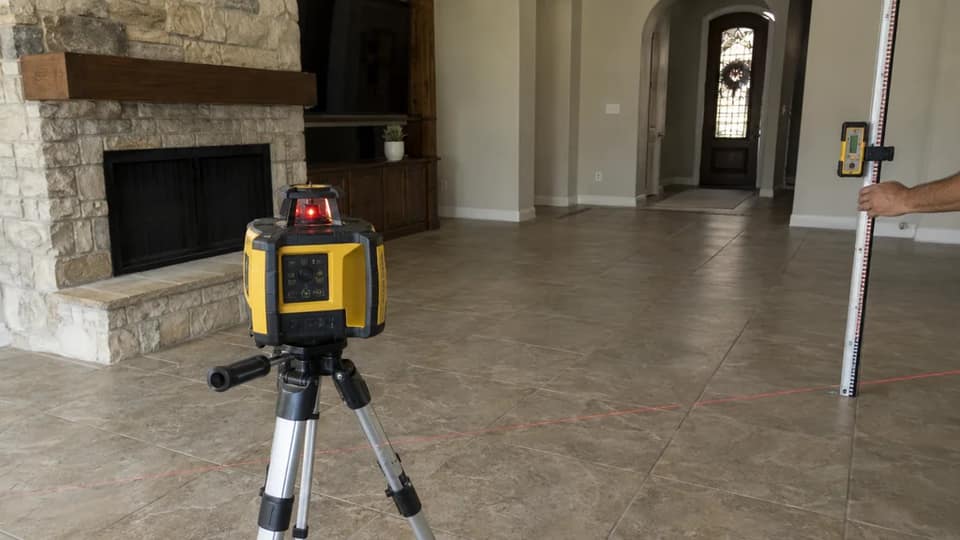
After piers are installed along the settled section, a bottle jack goes on top of each pier under the grade beam. The crew lifts in small increments, moving from jack to jack so the beam comes up evenly rather than bending at one point. Someone inside watches the cracks and the laser readings. When the target is reached, shims and caps are set, the jacks are released, and the house bears on the piers.
On the east side of New Braunfels, where the slabs are on deep clay, a lift of an inch and a half to two inches on a settled edge is routine. On the limestone side, lifts are usually smaller because the settlement was smaller; the problem there is more often a fill pocket under one part of the house.
Interior low spots that cannot be reached from the perimeter get interior piers through the slab, or in the case of a void without structural drop, polyurethane injection to raise the slab section a fraction of an inch. Mudjacking with a cement slurry is the older version of the same idea and is still used on driveways and patios.
Leveling a pier and beam home
Pier and beam leveling is more forgiving. The crew works from the crawlspace, jacking individual beams and setting shims on the posts or pads below. Because every support point can be adjusted independently, an old house on Academy Avenue or along Hunter Road in Gruene can be brought very close to level without the wholesale lift a slab needs.
The limiting factor is the wood. A beam that has sagged for fifty years has taken a permanent curve. Jacking it straight can crack it. In those cases the fix is a sister beam alongside it, and the floor above is leveled with shims on the subfloor rather than by forcing the old beam.
Expect plaster and drywall touch-ups after any meaningful pier and beam lift, and expect a few doors to need rehanging in the other direction.
Costs and what affects them
Leveling is priced through the supports that make it possible. For a slab, that is the pier count: pressed concrete piers at roughly $400 to $800 each and steel at $1,200 to $3,000 each, with most houses needing eight to fifteen. For a pier and beam home, a shim-and-level job runs $1,500 to $4,000 and climbs with new pads, posts and wood replacement.
Add-ons that show up on real estimates: a hydrostatic plumbing test before and after the lift, usually a few hundred dollars; interior slab breakouts; and drywall or brick repair after the lift, which the foundation contractor typically does not do.
A house that is level but still sitting on the same wet-dry clay cycle will drift again. Leveling without addressing the gutters, grading and watering is a temporary result.
Related services
Foundation Repair in New Braunfels and Comal County
A straight explanation of how a Central Texas foundation gets diagnosed and fixed, what it costs, and when you should wait.
Slab Foundation Repair in New Braunfels
Nearly every home built in Comal County since the 1970s sits on a slab. Here is how a settled slab gets underpinned, and which pier makes sense on which side of I-35.
Pier and Beam Foundation Repair
The 1890s to 1950s houses on Mill Street, Academy Avenue, Hunter Road and around the Seguin courthouse square sit on posts and beams. They are fixed from underneath, and done right they outlast the slab homes around them.
Drainage Correction and Foundation Protection
Piers fix what already moved. Drainage is what keeps the next section of the house from moving. On Comal County clay, it is not optional.
Foundation Inspection in New Braunfels
A foundation inspection is a set of measurements and a walk-around by someone who has seen a thousand Comal County slabs. Here is what it covers, what it does not, and when you need an engineer instead.
Foundation Crack Repair in New Braunfels
Every brick house in Comal County has a crack somewhere. The job is telling the ones that mean the soil is moving the house from the ones that just mean it is a brick house in Texas.
Questions homeowners ask
How level is level?
New slabs are allowed some tolerance from the day they are poured, and an inch of variation across a whole house is generally considered acceptable by Texas engineers. A lift that brings a two-and-a-half-inch drop back to under an inch is a successful lift.
Will leveling fix my cracked tile and drywall?
It stops the cause. Cracks in drywall often close partly during the lift but still need to be floated and painted. Cracked tile does not heal; it gets replaced after the house is stable.
Can a house be over-lifted?
Yes, and it is a real risk with an inexperienced crew. Over-lifting breaks brick, splits framing and can crack drain lines. A measured, incremental lift against a laser is the protection.
How soon can I repair the drywall and brick?
Give the house two to four weeks after the lift to settle onto its new supports before cosmetic repairs. Doing it the next day often means doing it twice.
Is polyurethane foam a substitute for piers?
No. Foam lifts and fills under slab sections and is excellent for garages, patios and interior voids. It does not provide deep bearing for a grade beam on active clay. A contractor who proposes foam alone for a settled perimeter is proposing the wrong tool.
Service area
Comal, Guadalupe and Hays County homes, roughly a 35 mile ring around New Braunfels.
Get a lift target in inches, not a promise
Call (830) 626-9042. A licensed, insured contractor measures the house and tells you what can be recovered before anyone touches a jack.
Calls may be recorded for quality and training. Your details go only to the contractor who will serve you. How this works