Cracks in Brick: Cosmetic or Foundation?
Almost every brick house in Comal County has a crack somewhere. Here is how to tell which ones are worth an inspection and which ones are just brick being brick.
Mon to Sat 7am to 7pm. Calls answered, not voicemail.
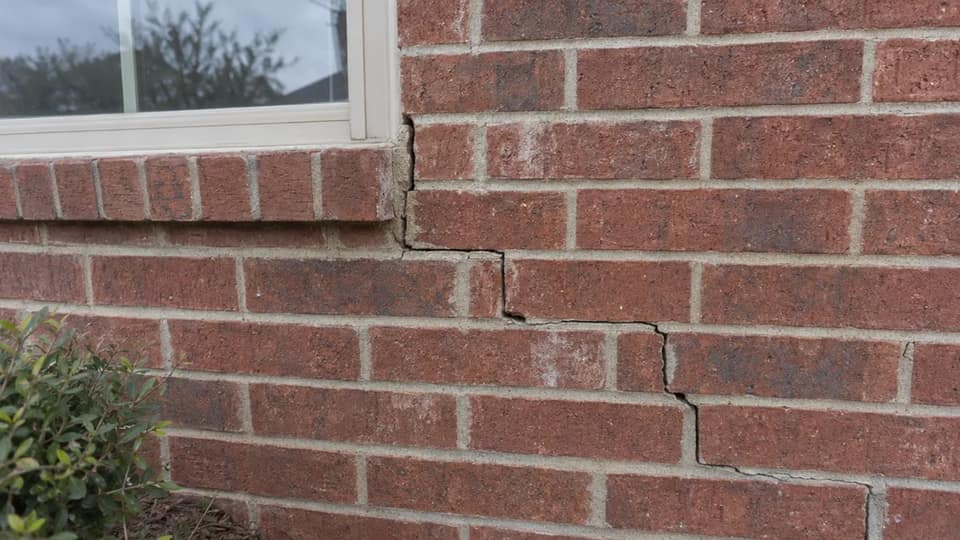
The crack patterns that matter
Brick veneer sits on the edge of the foundation, so it shows movement early. The pattern tells you more than the length.
- Stair-step cracks through the mortar joints, especially near a corner, usually mean that part of the foundation has dropped or lifted.
- Cracks wider at the top than the bottom often point to a corner settling away from the rest of the house.
- Cracks running from the corners of windows or doors, or a gap opening between the frame and the brick, suggest the wall has moved.
- A horizontal crack along a row of brick can mean the wall is rotating or the slab edge is moving.
- Cracks through the bricks themselves, not just the mortar, mean there was enough force to break masonry.
Cracks that are usually cosmetic
Hairline cracks in mortar under about 1/16 of an inch, with no pattern and no change over time, are common and usually come from shrinkage. Small vertical cracks near the top of a long wall can come from the brick expanding in summer heat. A cracked brick at a slab corner, called a corner pop, is its own case and is covered in our corner pop guide.
How to measure and track a crack
Width matters more than length. A crack wider than about 1/4 inch, or one that keeps growing, is worth an inspection.
Put a strip of painter's tape across the crack, mark both edges with a fine pen and write the date. Take a photo with a ruler or a coin for scale. Check again in a month and after the next big rain or dry spell. Clay soil moves with moisture, so a crack that opens in August and closes in spring tells you the slab is riding the clay.
Check inside too
Brick cracks plus interior signs are a stronger case than brick cracks alone. Look for doors that stick or will not latch, cracks in drywall running up from door corners, gaps between the ceiling and walls, tile cracking in a line, and floors you can feel sloping. Our guide on sticking doors and sloping floors goes through those.
Why this happens so often around New Braunfels
East of I-35, homes sit on clay that swells when wet and shrinks when dry. Each cycle moves the slab edge a little. Brick is stiff and cannot flex with it, so it cracks. Watering the foundation evenly in long dry spells and fixing gutters that dump water at one corner reduce the movement.
More foundation guides
Foundation Repair Cost in New Braunfels
Real ranges for Comal and Guadalupe County homes, what drives the number up or down, and how to read an estimate before you sign one.
How Much Does House Leveling Cost?
Leveling a house on blocks and lifting a settled slab are very different jobs. Here is what each one usually costs around New Braunfels and what moves the price.
Sticking Doors and Sloping Floors
Doors and floors are often the first place foundation movement shows up indoors. Here is how to tell seasonal swelling from a slab that is moving.
Foundation Corner Pops
That triangle of concrete cracking off the corner of your slab under the brick looks alarming. Most of the time it is not structural. Here is how to tell.
Steel vs Concrete Piers
The pier method is the biggest decision on a foundation estimate. Here is how the common types compare on New Braunfels clay and Hill Country limestone.
Related services
Foundation Repair in New Braunfels and Comal County
A straight explanation of how a Central Texas foundation gets diagnosed and fixed, what it costs, and when you should wait.
Slab Foundation Repair in New Braunfels
Nearly every home built in Comal County since the 1970s sits on a slab. Here is how a settled slab gets underpinned, and which pier makes sense on which side of I-35.
Pier and Beam Foundation Repair
The 1890s to 1950s houses on Mill Street, Academy Avenue, Hunter Road and around the Seguin courthouse square sit on posts and beams. They are fixed from underneath, and done right they outlast the slab homes around them.
House Leveling in New Braunfels
Leveling is the part of foundation repair homeowners picture: jacks under the house, the low corner coming back up. Here is what that actually involves and what it can realistically recover.
Drainage Correction and Foundation Protection
Piers fix what already moved. Drainage is what keeps the next section of the house from moving. On Comal County clay, it is not optional.
Foundation Inspection in New Braunfels
A foundation inspection is a set of measurements and a walk-around by someone who has seen a thousand Comal County slabs. Here is what it covers, what it does not, and when you need an engineer instead.
Foundation Crack Repair in New Braunfels
Every brick house in Comal County has a crack somewhere. The job is telling the ones that mean the soil is moving the house from the ones that just mean it is a brick house in Texas.
Questions homeowners ask
Should I fill brick cracks with caulk or mortar?
You can, to keep water out, but do it after you know whether the foundation is moving. Patching first hides the evidence an inspector would use.
How wide is too wide?
As a rule of thumb, anything over about 1/4 inch or anything that is growing should be looked at. Hairline cracks that never change are usually not structural.
Will a home inspector flag brick cracks?
Usually, yes. In a sale, a buyer's inspector often recommends an evaluation by a structural engineer when they see a pattern like stair-step cracking.
Do brick cracks close back up after repair?
Some partly close when the foundation is lifted. Most still need repointing or brick replacement for looks.
Service area
Comal, Guadalupe and Hays County homes, roughly a 35 mile ring around New Braunfels.
Have someone measure what you are seeing
Call (830) 626-9042 Monday through Saturday, 7am to 7pm. A local contractor measures first and puts the number in writing.
Calls may be recorded for quality and training. Your details go only to the contractor who will serve you. How this works